


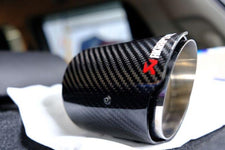

Carbon fiber exhaust tips are available in several surface patterns, but two styles attract particular attention: forged carbon and traditional 2x2 twill weave.
At first glance, the difference seems mostly visual. Forged carbon has an irregular, marble-like pattern, while twill carbon fiber features the familiar diagonal woven lines. However, the two styles can also involve different reinforcement arrangements and manufacturing methods.
If you are choosing carbon fiber exhaust tips for a modified car, understanding these differences can help you select a finish that matches your vehicle.
What Is 2x2 Twill Carbon Fiber?
2x2 twill is a common carbon fiber fabric weave. It uses interlaced fiber bundles arranged in a repeating diagonal pattern.
The name refers to the weaving structure rather than the number of carbon fiber layers.
Its recognizable appearance makes it popular for automotive exterior components, including mirror covers, spoilers, interior trim, and exhaust tip covers.
Typical characteristics include:
-
Repeating diagonal weave pattern.
-
Consistent visual texture.
-
Glossy or matte surface options.
-
A classic motorsport-inspired appearance.
-
Compatibility with different resin systems and composite manufacturing processes.
For a technical explanation of carbon fiber fabric structures, see Hexcel's Carbon Fiber Reinforcements.
What Is Forged Carbon Fiber?
Forged carbon is commonly associated with composite parts made using short or chopped carbon fiber reinforcement distributed within a resin matrix.
Instead of a regular woven pattern, the finished surface often has irregular shapes that resemble small fragments of carbon fiber.
Its appearance is quite different from traditional twill carbon.
Common visual characteristics include:
-
Random, irregular carbon patterns.
-
A distinctive marble-like appearance.
-
A modern motorsport-inspired style.
-
Glossy or matte surface possibilities.
-
Different visual patterns from one component to another.
The exact construction can vary between manufacturers. The term "forged carbon" alone does not establish the fiber length, resin system, or mechanical properties of a finished part.
Toray explains the different ways continuous carbon fibers can be woven or processed into discontinuous fiber materials in its Carbon Fiber Applications Guide.
Forged Carbon vs. Twill Weave: Main Differences
|
Comparison |
Forged Carbon |
2x2 Twill Carbon |
|---|---|---|
|
Surface pattern |
Irregular, marble-like |
Repeating diagonal weave |
|
Visual style |
Modern and distinctive |
Classic motorsport style |
|
Pattern consistency |
Naturally variable |
More regular |
|
Design preference |
Individual appearance |
Traditional carbon look |
|
Surface finish |
Glossy or matte |
Glossy or matte |
|
Main selection factor |
Visual pattern |
Weave appearance |
One important point: a different surface pattern does not automatically mean better strength, durability, or heat resistance.
Those properties depend on the complete composite structure, including fiber type, resin, laminate design, curing process, and manufacturing quality.
Which Carbon Fiber Style Looks Better on a Car?
The answer depends on the rest of the vehicle.
Forged carbon works particularly well when the car already has a modern, customized appearance. Its irregular pattern can create an interesting contrast against black body trim and dark rear diffusers.
Twill carbon is a more traditional choice. It is often easier to coordinate with other carbon fiber accessories that use a recognizable diagonal weave.
Consider these combinations:
-
Glossy forged carbon: suitable for a bold exterior appearance.
-
Matte forged carbon: suitable for a darker, understated build.
-
Glossy twill carbon: suitable for a classic performance-inspired look.
-
Matte twill carbon: suitable for subtle carbon fiber detailing.
If you want to compare different exterior options, visit Kipalm Carbon Fiber Accessories.
What Should You Check Before Buying?
The carbon pattern is only one part of the product.
Before choosing an exhaust tip, check:
-
Whether the product uses real carbon fiber or a decorative imitation.
-
The construction of the inner metal section.
-
The surface coating and finish.
-
Inlet and outlet dimensions.
-
Total product length.
-
Mounting method and bumper clearance.
For example, Kipalm lists a Forged Carbon Fiber Exhaust Tip with SUS304 Stainless Steel. This provides an example of a product combining a forged-carbon exterior with a stainless steel component.
Do not judge the quality of a carbon fiber exhaust tip by its surface pattern alone.
How to Maintain Carbon Fiber Exhaust Tips
Carbon fiber surfaces should be cleaned carefully.
A few simple habits can help preserve their appearance:
-
Allow the exhaust to cool before cleaning.
-
Use a soft microfiber cloth.
-
Avoid abrasive brushes.
-
Do not use aggressive polishing compounds.
-
Remove accumulated dirt and soot regularly.
-
Follow the coating manufacturer's cleaning recommendations.
Glossy and matte finishes may require different care, so always check the specific surface treatment.
Conclusion
Forged carbon and 2x2 twill carbon fiber offer two distinct approaches to automotive styling.
Forged carbon is a good choice for buyers who prefer an irregular, modern pattern. Twill carbon is more suitable for those who appreciate the traditional woven carbon appearance.
Neither style is automatically superior. The better choice depends on the product's construction, finish, fitment, and the overall design of your vehicle.
Explore Kipalm Single Exhaust Tips to compare available styles.
Frequently Asked Questions
Q1: Is forged carbon stronger than twill carbon fiber?
Not necessarily. Strength depends on the fiber architecture, resin system, laminate construction, and manufacturing process rather than the appearance of the surface alone.
Q2: What does 2x2 twill mean?
It describes a weave pattern in which each fiber bundle passes over two bundles and under two bundles in a repeating arrangement.
Q3: Can forged carbon exhaust tips have a glossy finish?
Yes. Forged carbon components can be finished with glossy or matte surface treatments, depending on the product.
Q4: Which carbon fiber pattern is better for BMW modifications?
Both can work. Twill offers a traditional motorsport appearance, while forged carbon provides a more distinctive visual style.
Q5: Does carbon fiber change exhaust sound?
The main purpose of a carbon fiber exhaust tip is visual customization. It should not be considered a replacement for an exhaust system designed to change sound.
